23 September 2006

Kyoto funding opportunity for BRT

The prospects of funding Bus Rapid Transit (BRT) in the 'Global South' just improved!

According to Business News Americas (found via http://www.transportnews.org)
The TransMilenio public transport system in Colombian capital Bogotá has become the first mass transit system in the world to be considered a clean development mechanism (CDM) in accordance with the Kyoto Protocol, the Andean Development Corporation (CAF) stated in a press release.

The UN Framework Convention on Climate Change (UNFCCC) has approved CAF's methodology to consider the TransMilenio scheme as having a CDM component.

This means that it is officially accepted that the TransMilenio system reduces the emission of greenhouse gases because of its greater efficiency in transporting passengers and due to the partial substitution of private means of transport by high quality public services.
This means that it will be "be eligible for carbon emission reduction certificates (CERs), which can be traded with developed countries to help the latter reach the carbon emission reduction goals set out under the Kyoto Protocol".

This answers a call made by Wright and Fulton in a paper that I reviewed last year. They argued that projects like Bogotá's BRT system, which involve mode shifts to inherently more efficient modes of transport, such as well-used public transport systems, are far more cost effective than efforts that focus on fuel technology. Their arguments focused especially on BRT as offering widespread opportunities.

It will be interesting to see if this sets a precedent that can be followed up on by many other similar projects.

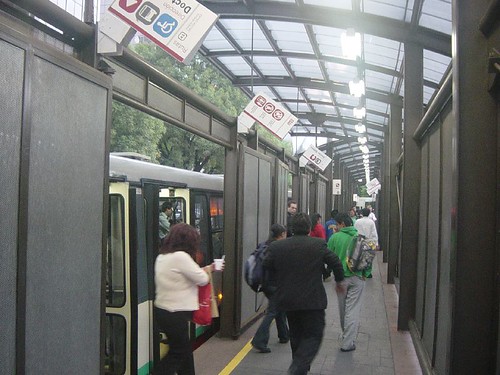
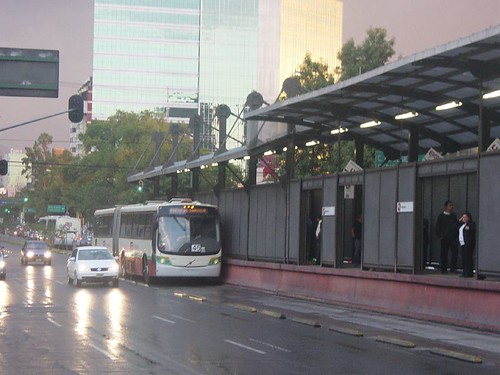
The photos with this post are of Mexico City's BRT line, known as Metrobus.

03 August 2006

'Naked streets' and safe chaos

I recommend taking a look at YouTube's GlobalSouth group which has more than 60 short videos now on transport in developing countries.

A striking number of the videos are simply footage of streets or intersections in countries like India, China or Vietnam. Most of them show traffic that at first glance looks completely and utterly CRAZY, often with a mind-boggling diversity of road users doing anything and everything you could imagine.

And the amazing thing is that it seems to work. For some good examples look here or here.

One traffic clip (this one of an Indian intersection) provoked hot discussion at sustran-discuss in April. Some saw it as horrifying, while others suggested it was actually working very well. No consensus emerged I am afraid (see here and several responses). By the way, the Indian video looks to me like it may have been deliberately sped up a little to improve the slapstick effect!

Here is one of the approving sustran-discuss comments:
As it happens, I shot a similar video last summer in Urumqi, except there's also a pedestrian crossing going through it which is freely used by the cars doing u-turns. I started to video it to show people how bad the traffic and driving was. After 10 minutes of filming I realised that it all worked rather well, and felt suitably humbled about my prejudices.
Let me assume for today that the chaotic looking situations in these videos are actually rather safe, with few serious accidents (although probably quite a few minor ones). This is a big assumption (and I don't have the evidence to make it) but it does not seem unreasonable.

The roads in these videos all seem somewhat 'naked' - along the lines of the 'shared space' approach to road and intersection design. Maybe they are inadvertently naked and not by careful design as shared space advocates might want. But these streets or intersections are working (maybe even working well!?) without all the traffic engineering paraphernalia or signs and traffic lights, etc. Or maybe the signs and lights are just being ignored.

Does this threaten to turn our quest for order and traffic discipline on its head? Maybe streets with vulnerable road users actually NEED a certain amount of chaos to work safely!? Maybe they need to have all those crazy turning movements, mixed vehicles, pedestrians meandering and bicycles sailing through in order to keep everyone awake and alert to the unpredictable? Maybe, as David Engwicht puts it, safe streets need more intrigue and uncertainty not more predictability.

Someone else wasn't so sure, however:
It is a trade-off of efficiency and safety! Similar driving behaviors
and situation in most of Chinese cities, resulting an "official record"
of 100,000 more fatalities and 520,000 more injuries annually!!
Indeed, some of the videos DO show examples of chaotic Chinese urban traffic going HORRIBLY wrong (WARNING: not for the squeamish - some of these crashes are a tad upsetting).

This made me wonder. A casual look suggests that the key difference might be speed. The accident scenes in the video from China almost all show situations in which the traffic is light and the speeds high, even though in most cases nothing much else is different about these crash intersections compared with other 'chaotic' intersections. This is more a question than a conclusion, of course, based on this little video-based 'investigation'!

But running with this idea for a minute anyway, maybe the horrendous traffic accident statistics that we read about low-income countries (high rates of accident per vehicle, not per capita) are not happening at the really 'crazy' times at all and are not a result of the obvious disregard for rules - at least not when it is at its most obvious?

Maybe these same chaotic places only become dangerous when the traffic is lighter, when there is not enough chaos, and the motor vehicles tend to pick up speed? A hypothesis that would be worth testing more carefully I think.

A bunch of other questions arise. I wonder if there are any simple design features for such places that could prevent speeds, and hence danger, from increasing at times when traffic is light?

The naked streets toolbox apparently can work such magic ... with designs that make it feel like a pedestrian or playing child or bicycle might leap out in front of you at any moment, even if there are none around. Could we find low cost ways to do this that would suit Indian or Vietnamese cities? Or maybe I don't know enough about shared spaces as done in Europe. Could it be that Dutch naked streets also get dangerous when there are too few people using them?I must find out.

On the traffic efficiency side there are other questions, which I will save for another day.

24 July 2006

Part 3 of "Moving Forward: towards better urban transport"

This is the third and final part of the video.
Part 2 of "Moving forward: towards better urban transport"

SUSTRAN Video "Moving forward" now online


Six years ago I helped produce an educational video on urban transport policy for the SUSTRAN Network (and some funds from the Southeast Asia Regional Canada Fund.

I have finally got around to putting it on YouTube. So here is Part 1, and Parts 2 and 3 will follow shortly.

Sorry they are a little grainy. The VCD version was never of super high quality.

"Moving forward : towards better urban transport" gives a brief introduction to some of the isssues related to modern urban transport in the 'global South', with a focus on Southeast Asia. It has footage from Burma, Malaysia, the Philippines, Thailand and Singapore, this documentary outlines problems associated with transport in cities. It also introduces some of the key tools to tackle these challenges, and make urban transport safer, cleaner, healthier and more people-friendly.

Credits: Produced in 2000 by the SUSTRAN Resource Centre (Malaysia) for the SUSTRAN Network, with the assistance of the Southeast Asia Regional Canada Fund. Produced and directed by Zaitun M. Kasim and Paul Barter. Video concept by Paul Barter, Tamim Raad, Zaitun M. Kasim; editing by Neil Felix, Pusat Komunikasi Masyarakat, Kuala Lumpur, Malaysia.

19 July 2006

Singapore taxis

[updated for brevity]

I was asked by the media to comment on the taxi industry in Singapore, which has been in the news here recently. These were some of my comments.

[BTW, since I first blogged this, some of the comments below have been mentioned in 'Today', 22 July 2006 in a long article which offers a pretty good overview of issues for the Singapore taxi industry.]


Background: Singapore's taxi deregulation
Singapore has 'deregulated' the taxi industry. But what does that mean?

First, there is now no cap on the number of taxis. And the numbers did indeed go up.

Second, there is no limit on the number of taxi companies (although complying with service standards means that tiny operators would have difficulty staying in the market).

Third, each taxi company can set fares to whatever the market will bear - provided they inform the government and the public in advance. Thus, deregulated fares does not mean unpredictable fares. The drivers must still use the tamper-proof meters. In practice, the differences among the companies are small and restricted mainly to the extras.

See here for the official line on the basics of Singapore's taxi deregulation policy (as of 2003) and here for a basic guide (for tourists) on Singapore's taxis.

Below is my take on a few specific issues.

A. Competition among the cab-owning companies not yet sufficient?
Most taxi drivers here rent their cab from one of the companies (at S$90 per day). The taxi companies are thus basically rental companies - with medium term rental agreements with the drivers of their fleet.

In this model, the drivers face an extremely competitive environment out on the streets.
The companies are competing to keep drivers so that their taxi fleets are fully utilised.

However, this competition does not yet appear very fierce. For example, drivers complain that the cab companies have never reduced their daily rental, even though COE prices have gone down. This complaint sounds like a fair comment.

Why have the companies not been offering lower rentals? There is certainly one dominant player in the industry (Comfort-Delgro) and it is hard not to wonder if this market dominance is the problem. On the other hand, there are reports that some of the companies now do have significant numbers of idle taxis. So maybe stiffer competition to retain drivers is coming soon? Or maybe there are grounds for requiring the market dominant player to divest part of its fleet?

BTW, see here for a brief official explanation of the thinking behind deregulation.


B. Exempt taxis (and car-share cars and car-rental cars) from purchase taxes like COE and ARF?
In Singapore private motor vehicle purchases are heavily taxed, via the Vehicle Quota Scheme (which results in an extra cost, the COE) and the Additional Registration Fee (ARF). Together with Excise Duty, these more than double the price of a new car. So a small car costs around S$60,000 (about US$38,000).

Taxis (and car-share and rental cars) are currently treated almost exactly like private cars for the purpose of these taxes (except for some small differences) (see for example, the 2002 Budget for the rationale - because they are like cars basically). So the cost structures of the taxi industry and car-sharing (eg NTUC car-coop) and car rental are heavily weighed down by COE and ARF.

BUT I beg to differ. The rationale for ARF and COE is to contain the rate of growth of privately owned motor vehicles? Carsharing, taxis and car rentals (together with public transport, walking and cycling) are among the ALTERNATIVES to owning your own private vehicle.

So exempting these industries from COE and ARF would be in line with the objectives of these taxes.

Would this cause some of these low-tax vehicles to leak into the private car fleet? I don't think so. It is easy to enforce such things with relatively few actors in the industry.

Of course, lower capital costs for taxis will not help drivers or customers, unless there is real competition among the cab companies so that they pass on the savings (see point A above).


C. Peak period issue - allow 'ERP on entry' to be passed to next customer?
Singapore's taxi users have long complained about how difficult it can be to get a cab in peak periods. Peak hour surcharges are aimed at fixing that problem and probably do help.

BUT, one part of the afternoon peak problem for taxis has not been solved yet. It is an unintended side-effect of the Electronic Road Pricing (ERP) cordon around the city centre. Taxi passengers have to pay for ERP. However, for an empty cab ERP costs the driver. This creates an artificial shortage of taxis in the central zone in the late afternoons when few occupied cabs are entering the area and empty ones avoid the extra cost of ERP.

Here is a suggestion. How about we change the rules to allow cabs enteringt empty to automatically add the ERP charge to the next fare. I suspect that taxi meters could handle this, since they are already equipped to add on various surcharges and ERP costs. This "ERP needs paying" status could also be displayed somehow - say on the cab's rooftop display or simply with a low-tech sign (like the change of shift signs).

In evening peak, some customers will be willing to pay this extra in order to get a cab. Some will not. Which is not a problem. They will just continue to wait for a cab without ERP to pay.

The driver would need to be able to cancel the extra ERP charge in case he/she cannot quickly find a willing customer. If no luck, then just cancel it and swallow the loss.

We would need to think through how this would work at cab ranks. I don't think these issues would be impossible though. So maybe this idea is worthy considering?


Mexico City impressions

Recently I was lucky enough to visit Mexico. Here are a few observations and impressions.

I am grateful to Bernardo Baranda (formerly with the Center for Sustainable Transport Mexico (Centro de Transporte Sustenable, and now Mexico country director with ITDP) for helping me learn more about the transport scene in Mexico City.

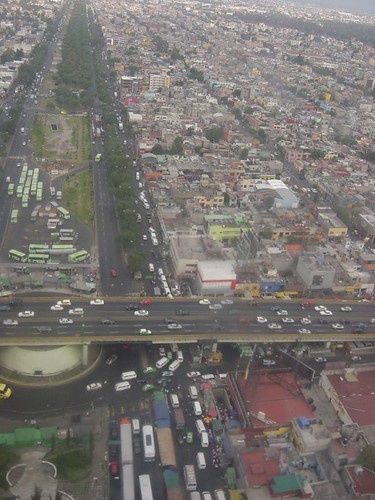
As I flew in I was struck by the grid layout and that the city was low-rise (rarely more than 2 or 3 storeys) mostly. Also impressive was the sheer scale of the place (around 20 million in the metropolitan area I was told) and the bright colours of many houses. This was my first time anywhere in Latin America so I couldn't help but make comparisons and contrasts with Asian middle-income and low-income cities that I am more familiar with.


Here are a few transport-related impressions that I jotted down along the way.

The large number of street stalls and hawkers surprised me, especially near Metro stations, possibly more even than in Bangkok or Jakarta... And more tolerance of them apparently.

The Metro has rubber tyred wheels, is very frequent, very extensive, mostly crowded, and much cleaner than books had made me expect.


Most housing and buildings tend to front onto the street even in outer areas. I didn't see any really suburban looking places. However, I did find a few US-style strip mall areas, complete with Wal-Mart (although I was pleased to notice that its car parking was not free).

The historic centre has a rather European look and feel to me, certainly much more so that I am familiar with in Southeast Asia, where local and Chinese styles are just as prominent

I was impressed by the quality of public spaces, especially the many squares (plazas), which are very well used and lively. It is hard to find such wonderful public spaces in Southeast Asia. And despite various dire warnings about crime and personal security, I never felt threatened.

Public transport is incredibly cheap. For example tickets to the Metro are per entry 2 pesos per entry (unlimited distance). Two pesos is just under 20 US cents.

Minibuses ('peseros') are ubiquitous and appear to fill a real need as feeder services to metro as well as for longer rides to some extent. They have been steadily increasing in numbers, causing some concern to some.

The metrobus busway seems successful. Actually another city, Leon, was first to build BRT in Mexico. Leon is apparently lucky to have an institute for urban policy (or something like that) that does very good planning; their busways have been done very well at relatively low cost. Bernardo reports that it is estimated that Mexico City's Insugentes busway is carrying about 250,000 per day with just 80 buses, a little more than the 220,000 or so who were carried before by hundreds of Peseros, and ordinary buses. (BTW the newly elected Mayor of Mexico City has recently announced plans for several more busway corridors). Read more about Metrobus's early success here. It is also estimated that 5% of busway users were not public transport users before, so some success in making public transport attractive to richer groups. This particular corridor is a rather upmarket one in general. By contrast, the Metro apparently has a poor image with many of the middle and higher income groups, for being crowded and difficult to access with vendors crowd all approaches.

I didn't witness much serious congestion. Maybe I was never at the right places at the right times. Nevertheless, this surprised me having heard so many stories about legendary Mexico City traffic jams.

The pedestrian environment was generally good I thought. Certainly not as bad as I had thought it would be and much better than in many Southeast Asian cities.

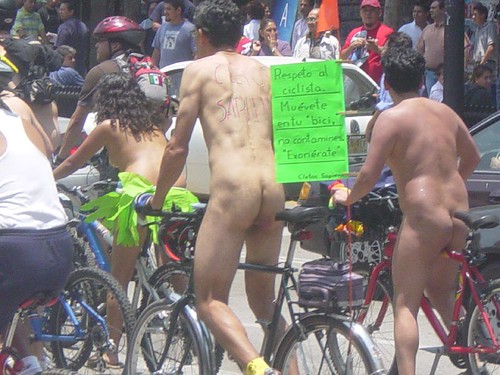
Efforts to help bicycle users are in their early stages, but there are already a few bicycle ways. The efforts so far are being strongly encouraged by a vocal and enthusiastic group of bicycle activists as well as the CTS ('Centro de Transporte Sustenable'). By chance I witnessed one of the bicycle activist events - a NUDE bike ride, which had more than 100 riders. The Sunday crowds in the historical centre gaped at the extraordinary sight. A very successful event in that it got huge press coverage (including TV news and front page of several papers) despite competing with the fierce election season and the football World Cup! And no, I did NOT participate myself.

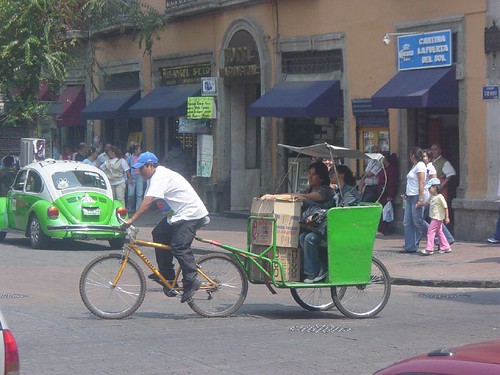
I also saw quite a number of pedicabs, using mountain bikes fitted with trailers. Quite nifty really. Most of the ones I saw were in and around the historic centre, near the Zocalo. But also saw one or two working in the outer suburbs in poor neighbourhoods. As the nude bike rally (mentioned above) was passing by I happened to be standing beside a pedicab driver. With my rather poor Spanish I managed to ask him why HE had his clothes on. Luckily for me he did not take offence. Just laughed and said they are all loco! Loco!

If you want to read more about Mexico City try here and for more on its urban transport issues in Mexico City you could start here (pdf).